
Category: Uncategorized

  • OpenADMET’s CYP inhibition blind challenge

    Cytochrome P450 occupy a central role in drug discovery, drug interactions with these enzymes can be described in three ways, metabolism, inhibition and induction. Since CYP450 metabolism is the major route for elimination of many drugs anything that interferes with that process can have profound effects. CYP450 inhibition can prolong the half-life of the given drug but can also change the exposure to any other co-administered drugs, and since particularly in the elderly [DOI], patients may be taking multiple medicines this can be a significant concern. CYP450 enzyme induction has the opposite effect, increasing levels of enzymes (and MDR1)often via activation of the Pregnane X receptor (PXR) and thus potentially lowering the exposure of the drug.

    Whilst there are many CYP450 enzymes four enzymes have been selected for the OpenADMET challenge CYP3A4, CYP2C9, CYP2D6, and CYP1A2 and as the plot above shows these are the most important enzymes for drug metabolism. More details of the OpenADMET’s CYP inhibition blind challenge are on the website. https://openadmet.ghost.io/announcing-openadmets-cyp-inhibition-blind-challenge/
  • OpenADMET update

    The latest OpenADMET newsletter is out, highlights include


    Generated nearly 150,000 measurements
     across more than 30,000 compounds: the largest publicly available ADMET datasets worldwide, representing a more than 10x increase in publicly available data.

    Solved 184 co-crystal structures of small molecules bound to PXR, effectively tripling the publicly available data for this target.

    Run three highly successful blind challenges, with the two most recent each attracting more than 350 groups.

    You can read the newsletter in full here https://openadmet.ghost.io/openadmet-quarterly-newsletter-q2-2026/?ref=openadmet-newsletter

  • ChEMBL 37 is out

    The latest update of the ChEMBL database is out. There are now nearly 3 million structures, 2 million assays covering over 18,000 targets. One of the big updates has been the targeted protein degradation.

    2,921,148 compounds (of which 2,897,819 have mol files)
    3,824,604 compound records (non-unique compounds)
    24,527,044 activities
    1,970,438 assays
    18,552 targets
    101,100 documents

    Full details can be found here https://ftp.ebi.ac.uk/pub/databases/chembl/ChEMBLdb/releases/chembl_37/chembl_37_release_notes.txt

    and the latest downloads are here

    https://ftp.ebi.ac.uk/pub/databases/chembl/ChEMBLdb/latest

  • Avinas announces the first approval of a PROTAC

    Avinas announces the first approval of a PROTAC

    Arvinas, Inc. (Nasdaq: ARVN), announced that the U.S. Food and Drug Administration (FDA) has granted approval for VEPPANU (vepdegestrant, ARV-471) for the treatment of adults with estrogen receptor-positive (ER+)/human epidermal growth factor receptor 2-negative (HER2-), estrogen receptor 1 (ESR1)-mutated advanced or metastatic breast cancer.

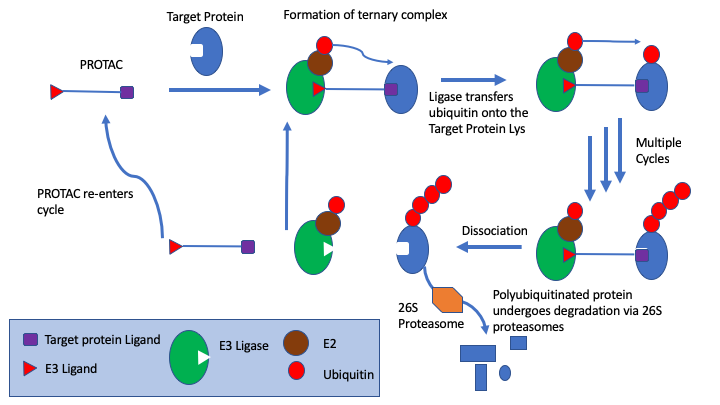
    PROTACs are bifunctional molecules that bind to the target protein and an E3 ligase, the simultaneous PROTAC binding of two proteins brings the target protein in close enough proximity for polyubiquitination by the E2 enzyme associated to the E3 ligase, which flags the target protein for degradation through the proteasome. There is more information here https://cambridgemedchemconsulting.com/proteolysis-targeting-chimeras-protacs/ including a list of PROTACS in development.